


Ask a merchant about payment costs, and the conversation usually goes in one direction.
Interchange rates. Merchant discount rates. Transaction fees. Terminal rental.
The focus is often on the visible costs that appear on statements and invoices each month.
Yet many businesses spend significant time negotiating a few basis points off their payment acceptance costs while overlooking something far more expensive happening inside their own operations.
Consider a finance team that spends several hours every week reconciling transactions across multiple payment methods. Or a store manager who manually verifies settlements from different providers. Or a customer service team investigating payment disputes because information is spread across multiple systems.
None of these costs appear as a line item on a payment statement. Yet collectively, they may have a greater impact on profitability than the transaction fees merchants work so hard to reduce.
The reality is that many businesses do not have a payment cost problem.
They have an operational efficiency problem.

The costs merchants can see versus the costs they cannot
Payment fees are easy to identify because they are visible. Every month, merchants can review statements and see exactly how much they paid in processing costs.
Operational inefficiencies are different. They are spread across departments, hidden inside day-to-day activities, and rarely measured directly.
Research consistently shows that businesses often underestimate the financial impact of manual processes. Time spent reconciling data, correcting errors, investigating discrepancies, and managing fragmented workflows rarely appears in formal cost calculations, even though it directly affects margins and scalability. (1)
This creates a common blind spot. Businesses optimise the costs they can see while overlooking the costs they absorb every day.
The hidden cost of reconciliation
One of the biggest examples is reconciliation. Modern merchants rarely accept a single payment method. A typical business may support cards, QR payments, online banking, e-wallets, online payments, and in-store transactions. Each channel often comes with different reporting formats, settlement timelines, and operational processes.
What appears to be a simple payment environment on the customer side can become surprisingly complex behind the scenes.
Industry experts continue to identify reconciliation inefficiencies as one of the most common operational pain points in modern payment environments. Manual reconciliation requires teams to export data, compare reports, investigate mismatches, and resolve discrepancies that consume significant amounts of time. (2)
The challenge becomes even more pronounced as businesses grow. More payment channels create more data. More data creates more operational overhead.
Eventually, teams spend more time validating information than acting on it.
Fragmentation creates a hidden tax on growth
Many businesses add payment solutions incrementally. A QR solution is introduced to meet customer demand. An online payment gateway is added for e-commerce. A separate provider supports another channel.
Each decision may be entirely reasonable on its own. The problem emerges when these systems fail to work together.
Payment fragmentation creates operational silos that affect reporting, visibility, reconciliation, customer service, and decision-making. Industry analysis increasingly describes this as a form of “fragmentation tax” where businesses lose time and resources simply managing disconnected systems. (3)
What begins as a payment acceptance strategy gradually becomes an operational burden.
The irony is that many businesses adopt additional payment solutions to improve customer convenience, only to create complexity internally.
Visibility matters more than many merchants realise
Payment costs are not only about money leaving the business. They are also about understanding what is happening inside the business.
Lack of visibility can create challenges around:
- cash flow forecasting
- settlement tracking
- performance reporting
- operational planning
Finance teams often struggle when payment information is scattered across multiple systems. Without a consolidated view of transactions, organisations may find it difficult to identify trends, spot anomalies, or make informed business decisions.
Research on payment operations consistently highlights the importance of visibility and automation in reducing operational overhead and improving financial management. (5)
Good payment infrastructure does not simply move money. It helps businesses understand their money.
The true cost of manual work
Perhaps the most overlooked payment cost is time.
Every manual process consumes resources that could be directed elsewhere. Finance teams spend time reconciling transactions. Operations teams investigate discrepancies. Customer service teams handle payment-related enquiries. Management teams work with incomplete information.
According to IDC research cited by operational efficiency specialists, businesses can lose between 20% and 30% of revenue annually to inefficiencies across their operations. While not specific to payments alone, the finding highlights how operational friction can have a far greater financial impact than many organisations realise. (4)
This is why reducing payment costs should not be viewed purely as a fee optimisation exercise.
The larger opportunity often lies in reducing operational effort.
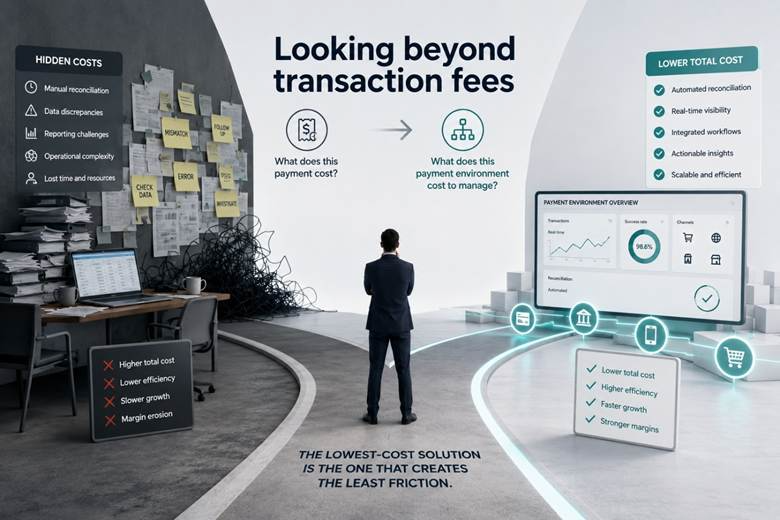
Looking beyond transaction fees
The payments industry is evolving.
As businesses adopt more payment methods and operate across more channels, the operational side of payments becomes increasingly important.
The conversation is gradually shifting from:
“What does this payment cost?”
to:
“What does this payment environment cost to manage?”
These are not the same question.
A payment solution with slightly lower transaction fees may ultimately be more expensive if it creates additional reconciliation work, reporting challenges, or operational complexity.
Likewise, a well-integrated payment environment may create savings that far exceed differences in processing costs.
As payment ecosystems become increasingly real-time and interconnected, industry research suggests that operational efficiency and infrastructure design are becoming just as important as payment acceptance itself. (6)
The lowest-cost payment solution is not always the one with the lowest fee.
It is often the one that creates the least friction.
Where AmpersandPay and CoherentPlus fit
Rather than viewing payments as isolated transactions, AmpersandPay focuses on helping merchants manage payment acceptance, reporting, and operational visibility through a more unified environment. The goal is not simply to support multiple payment methods, but to reduce the operational complexity that often accompanies them.
At the infrastructure layer, CoherentPlus supports payment ecosystems across retail, transit, parking, EV charging, vending, and unattended environments where operational efficiency and reliability are critical. As payment environments become more complex, integration and visibility become increasingly important alongside payment acceptance itself.
Final thoughts
Many merchants spend considerable time focusing on transaction fees. That makes sense. They are visible, measurable, and easy to compare. The larger costs, however, are often hidden inside operational workflows.
Manual reconciliation. Fragmented reporting. Limited visibility. Disconnected systems.
These inefficiencies rarely appear on invoices, but they affect profitability every day. In 2026, the question is no longer simply how much a payment costs. It is how much effort the business spends managing it. Because the true cost of payments is often not found in the transaction itself.
It is found in everything that happens afterwards.
References
(1) Prospect Analysis, The Hidden Cost of Manual Processes in Growing Small Businesses https://www.business-money.com/announcements/the-hidden-cost-of-manual-processes-in-growing-small-businesses/
(2) ACI Worldwide, 6 Signs Reconciliation Inefficiencies Are Burdening Your Business https://www.aciworldwide.com/blog/6-signs-reconciliation-inefficiencies-are-burdening-your-business
(3) The Payments Association, The Fragmentation Tax: How Payment Complexity Stifles Growth https://thepaymentsassociation.org/article/the-fragmentation-tax-how-payment-complexity-stifles-growth-and-how-unified-ecosystems-are-the-answer/
(4) IDC research cited by Reckon Financial Services, 3 Efficiency Drains That Cost Companies Millions https://www.reckonfs.com/post/3-efficiency-drains-that-cost-companies-millions
(5) CGAP, Digitizing Merchant Payments: Why and How https://www.cgap.org/research/publication/digitizing-merchant-payments-why-and-how
(6) Bank for International Settlements (BIS), Pricing in Fast Payments https://www.bis.org/publ/work1295.pdf